Song of Songs on Instagram
Shir HaShirim is read on Shabbat Chol HaMoed Pesach — but what connects an ancient love poem to the digital age? This article explores how deep, uncontainable love challenges Instagram culture, the pursuit of likes, and human relationships on social media.
On Shabbat Chol HaMoed Pesach, before the Torah scroll is opened, Ashkenazi communities read Megillas Shir HaShirim. Not a mizmor, not a tefillah — a shir ahavah. A love poem. First thing in the morning, before everything else.
Rabbi Akiva taught that while all of Kesuvim are kodesh, Shir HaShirim is Kodesh Kodashim. And yet — on its surface, it reads as a song between a man and a woman. Generation after generation, every meforash has wrestled with the same question: what is it doing here?
But perhaps the deeper question runs the other way: what does it tell us about ahavah, that it — of all things — was chosen as Kodesh Kodashim?
The Story That Disappears After 24 Hours
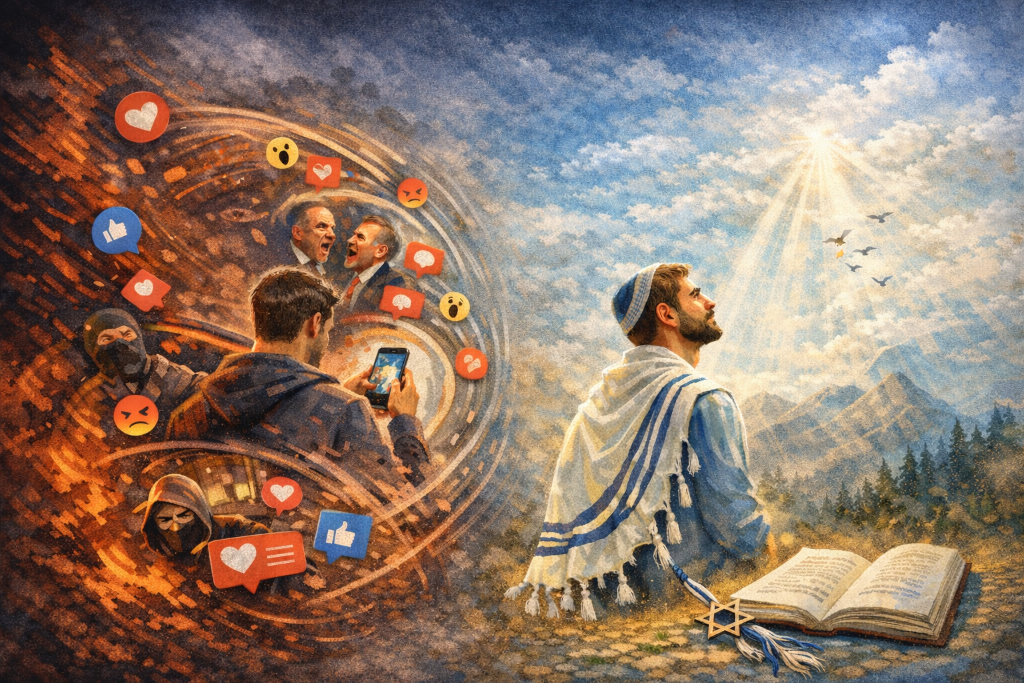
The generation growing up in our shuls today has come of age on digital love. That's not a criticism — it's simply a description of the world they inhabit. The first date begins on a screen, emotion is translated into a text, and intimacy is measured in how many seconds someone spent on your Story before it vanished.
These platforms aren't inherently the enemy of connection. They allow people to reach each other, to express themselves, to be present in someone's day. But they carry a built-in cheshbon: everything is fleeting, everything is immediate, everything is quantifiable. Number of likes. Watch time. Did he see it? Did she respond?
The ahavah of Shir HaShirim is built on an entirely different foundation.
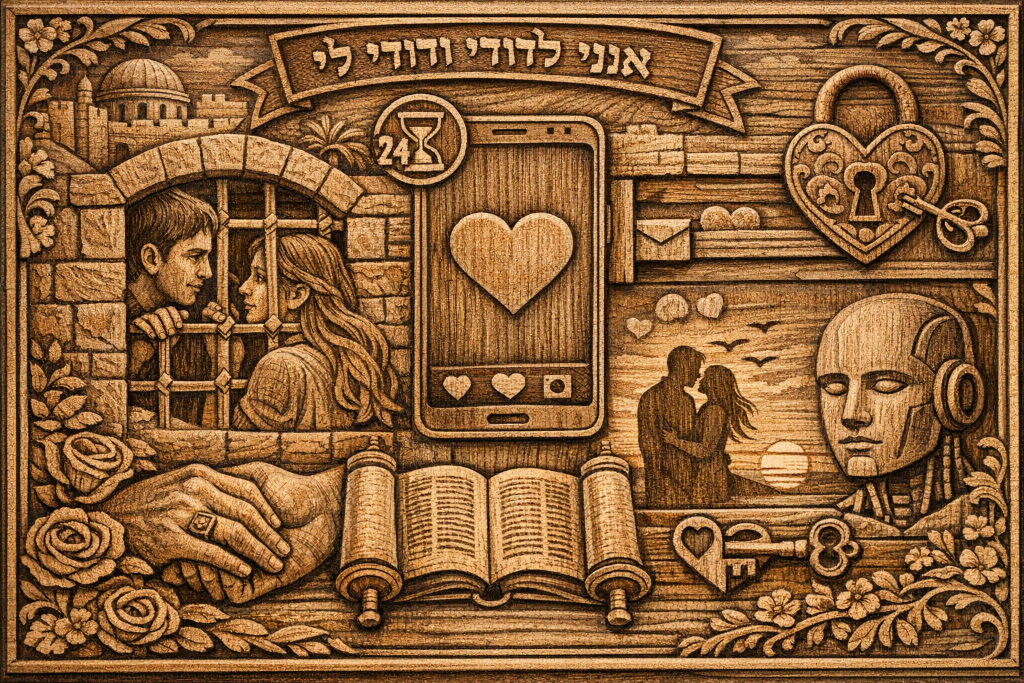
"Hinei zeh omed achar kosleinu, mashgiach min ha-chalones, meitzitz min ha-charakim" — the dod stands behind the wall, peering through the lattice. He doesn't send a message. He doesn't mark it "read." He is simply there. Present. Waiting. That is a fundamentally different quality of attention — one our generation desperately needs to rediscover.
Not "Read" — Present
One of the subtler things technology has done to us is flatten presence into a binary: read / unread. Seen / not seen. Online / offline.
But Shir HaShirim teaches that genuine presence isn't a status — it's a commitment. "Ani l'dodi v'dodi li" is not a status update. It is a declaration of identity. Who I am is defined by whom I am bound to.
This is the profound meaning behind reading Shir HaShirim specifically on Pesach. Yetzias Mitzrayim was not only a departure from something — it was a journey toward Someone. Not just freedom from Pharaoh, but, as Hoshea says, "V'erashtich li l'olam" — betrothal. From avdus to zivug. From slavery to covenant.
Geulah is not abstract liberty. It is relationship.
What AI Cannot Do
In recent years, apps have emerged offering "emotional companionship" through artificial intelligence — chatbots that listen, respond, and "remember." Some people, including frum people navigating loneliness, find genuine comfort in them, and that's worth taking seriously rather than dismissing.
But there is one thing AI is structurally incapable of doing, and it can be stated with precision: it cannot choose you. It is not waiting for you. It does not feel your absence. It has no fear of losing you. It simply — functions.
"Simeini kachotam al libecha, kachotam al zero'echa, ki azah chamavet ahavah" — the force of this pasuk lies in its exactness. Ahavah azah chamavet — love as strong as death. Death is inevitable, inescapable, absolute. Love as strong as death is love from which there is no return — where someone has chosen you and cannot un-choose you.
That is what no algorithm can offer. That irreversibility is precisely the point.
The Lattices Through Which We Look
There is one more layer worth sitting with. Shir HaShirim is full of charakim, windows, barriers. "Meitzitz min ha-charakim." The lovers see one another through the things that stand between them.
Perhaps the screen is the charak of our generation.
It need not be the enemy. Like the wall in Shir HaShirim, it can be the place from which one peers — the means through which one searches. The question is never simply whether to use it, but what one is searching for through it. Is the charak a destination, or a doorway toward something real?
What Is Read Before Everything
Chazal chose Shir HaShirim to be read before the Torah scroll is even opened on this Shabbos. Before the mitzvos, before the halachos, before the great story of Yetzias Mitzrayim unfolds — ahavah.
As if they were telling us: everything that follows — all of Yiddishkeit, the entire relationship with the Ribbono Shel Olam, every mitzvah — flows from this. From "Ani l'dodi v'dodi li." From a bechira hadadis — a mutual, irrevocable choice.
In an age where everything is instant, measurable, and forgotten after 24 hours — perhaps the most countercultural, most revolutionary thing a person can do is to love the way Shir HaShirim teaches: with depth, with presence, and with permanence.