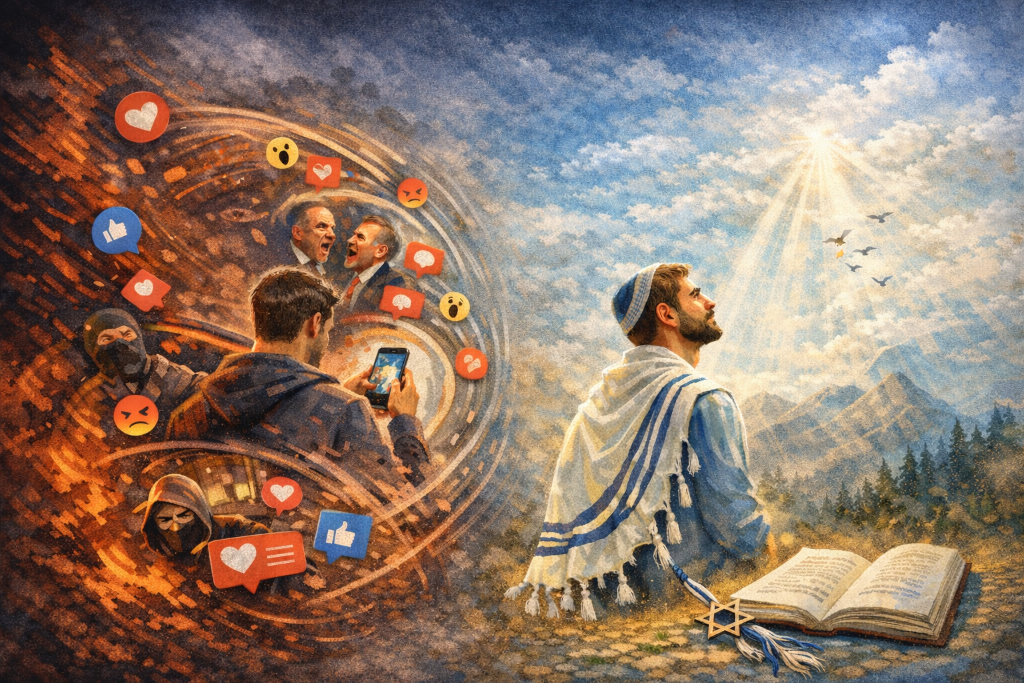
"You Shall Not Stray" in the Age of Social Media
A verse from Parashat Shelach-Lecha was written thousands of years ago, yet it seems to speak directly to the digital reality of our time. On the algorithm, the soul, and the power to choose where we look.
The verse from Parashat Shelach-Lecha, "You shall not stray after your hearts and after your eyes, after which you go astray," was written thousands of years ago, yet it seems to speak directly to the digital reality of our time.
The Ramban explains that the eye is the messenger of the heart: what a person sees, he desires, and what he desires, he pursues. The tzitzit comes to counter this — to redirect the gaze upward, toward the commandments, rather than wandering and being swept away. And here lies the precise paradox of social media: it is built, at the most fundamental engineering level, as a wandering machine. The infinite feed has no end and no natural stopping point. The algorithm learns what stimulates you and serves you more and more of it, wandering on your behalf and returning to you your exact desires. Every post is directly connected to an emotional response — envy, lust, anger, the impulse to judge. Precisely the two dimensions the Torah warns against — heart and eyes — are activated simultaneously, again and again, for hours each day.
The Sages extended the prohibition to include heresy as well — wandering after doubts and foreign beliefs. On social networks, this takes on a new face: relentless exposure to extreme opinions, conspiracy theories, and opposing values, all presented in a format that appears credible and persuasive. The "straying" here is intellectual and spiritual, not merely sensory. A person who opens their phone in the morning and begins scrolling may find themselves, within minutes, in the middle of a theological debate, a painful economic comparison, a political provocation, and an image that arouses desire. Each of these alone would require serious reckoning; together, they overwhelm every capacity for conscious judgment.
And there is yet another layer. The Torah speaks of "straying after your hearts" as a process that begins with the eye and ends in harlotry — that is, in disconnection from commitment. Social media is not only seductive; it is also forgetful. A person who has wandered through the feed for two hours finds himself distant not only from what he planned to do, but sometimes from who he wanted to be. Identity scatters, the hierarchy of values blurs, and the connection to something greater quietly loosens.
But the tzitzit did not abolish sight — it directed it. So too here: the question is not only "how much" but "from what place." Am I straying after envy and desire, or am I using the medium intentionally — for connection, creation, and learning?
The innovative conclusion is this: perhaps the real problem is not that we use social media too much, but that we refuse to acknowledge that it has reshaped the very structure of our souls. "You shall not stray" was not addressed to a person who sins inadvertently — it was addressed to a person who built for himself a lifestyle of wandering and found comfort in it. The greatest danger of social media is not addiction, which can be treated, but habituation: the moment when a person ceases to feel that he is wandering, because wandering has become his home.
Therefore, the true remedy is not a digital detox or screen-time limits, but rather the rebuilding of the inner capacity to "stand" — the ability to dwell, to focus, to choose where we look. This is not a question of technology. It is a question of who we want to be.