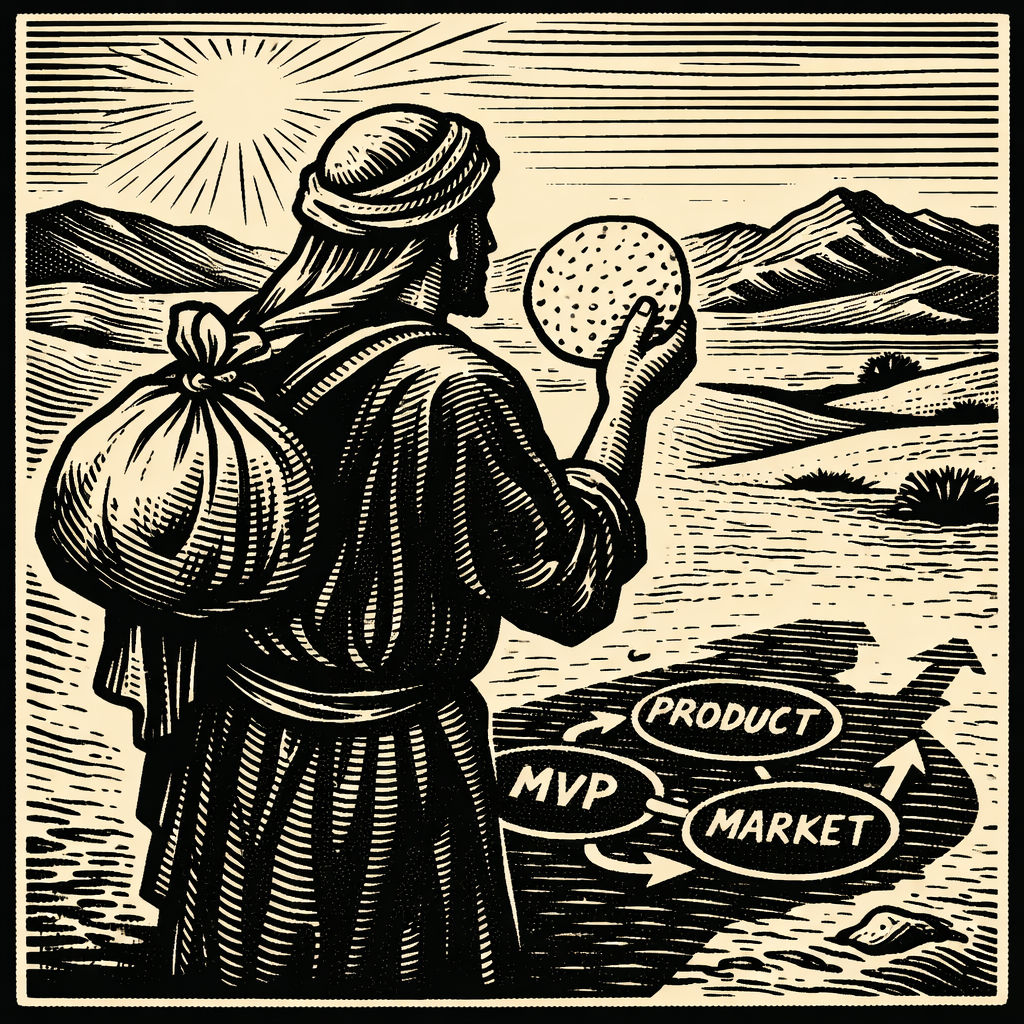
Matzah and the Minimal Viable Product
Bread that didn't have time to rise, and what entrepreneurs can learn from it. On the connection between the Exodus and the principles of modern entrepreneurship — MVP, urgency born of clarity, and early release as redemption itself.
"And they baked the dough which they had brought out of Egypt into unleavened cakes, for it had not leavened, because they were driven out of Egypt and could not delay." (Exodus 12:39)
This verse is usually read as retrospective explanation. The Israelites left Egypt carrying dough that hadn't risen, because they had no time. They would be forced to eat flatbread in the desert. Later, in hindsight, matzah became an annual obligation — a great symbol of freedom.
But it's worth pausing to ask: is matzah really a failure? Did the Israelites "not manage" to bake bread, or did they leave with precisely what they needed in order to leave at all? Leavened dough is dough that waited. And whoever waited, did not go free.
What Is an MVP, Really?
In 2001, Eric Ries — building on the work of Steve Blank — articulated one of the central principles of modern tech entrepreneurship: don't build the full product. Build the minimal version capable of answering the single most important question. Go to market. Get feedback. Correct. Repeat. A Minimal Viable Product is not a flawed product. It is a product precisely calibrated to the current state of your knowledge.
The failure of most startups is not that they launched too early. The failure is that they waited too long, built too much, invested too much — and then discovered that no one wanted what they had built. Leavened dough. Perfect bread. But by then, Egypt had already closed its gates.
Matzah, in this sense, is not a symbol of lacking. It is a symbol of correct priorities. Of knowing what matters now and what can wait. Of understanding that leaving Egypt on flatbread is infinitely preferable to not leaving at all with a perfect challah.
The Dough That Waited: On the Uncounted Cost of Delay
The Sages noted the precise phrase: "could not delay." Not "did not want to." Not "did not manage to." They could not. The waiting was impossible — not because time was short, but because the window was open, and a single moment of hesitation would have closed it.
In the startup world, this is called the Window of Opportunity. A window that opens briefly: a market just forming, a technology newly accessible, a problem that has reached a critical point of pain, a competitor who has entered and created demand. Those who wait for their product to be perfect often discover that by the time they finish, someone else has already gone to market with less-leavened dough — and has captured the space.
The cost of waiting doesn't appear on any spreadsheet. In the "expenses" column you record engineer salaries and server costs. You don't record the cost of the time during which your customer solved their problem with a worse competitor and now won't switch. You don't record the cost of team morale eroded by endless revision cycles that never ship. You don't record the cost of the knowledge you never gained because you never received feedback from real customers in the real world.
The cost of waiting is precisely the cost of chametz: what you could have gained had you left on time.
Three Layers of Matzah
Nachmanides asked: why do we eat matzah as a commemoration of redemption? Matzah was an expression of haste, of deprivation, of the bread of affliction. Why memorialize the lack? His answer is that matzah memorializes not the lack, but the choice within the lack. The people who left Egypt could have waited for bread. They chose not to. And that choice — to go even when everything is not ready — is itself the redemption.
Here lies the essential difference between three levels of entrepreneurship:
The first level: matzah from necessity. The founder shipped an MVP not because he believed in the approach, but because the money ran out. The half-finished version embarrasses him in every customer conversation. He explains that it's "only a pilot," that the "real product" is coming in six months. He behaves like someone who left Egypt in shame, not like someone holding bread that embodies a principle.
The second level: matzah by method. The founder shipped because of a framework. He read the Lean Startup books. He knows you must validate assumptions. He built the minimum and went to test it. This is good. But something is still missing. He executes matzah as a tactic, not as a philosophy.
The third level: matzah as principle. The founder understands that matzah is not the stage before bread. Matzah is the right bread for this moment. Its simplicity is not a weakness — it is an expression of clarity. Of knowing what matters. Of accepting the reality in which you currently stand. A founder at this level does not apologize for the MVP. He is proud of it — not because he is lazy, but because he understands that what ships small and fast is precisely what makes possible what comes next.
"Bread of Affliction": On the Pride That Kills Startups
The Haggadah gives matzah another name: lachma anya — bread of affliction. The poverty here is not necessarily material. It describes bread with no layers, no volume, no inner richness. Bread that is exactly what it is, and nothing more.
One of the most common causes of startup failure is not a lack of talent and not a lack of funding. It is product pride. The tendency to build more than is needed — not because the customer asked, but because a fuller product will be impressive. Because in the demo meeting, when every feature is presented, there will be a deep feeling of: look what we made.
This pride is expensive. Every feature added before validating that it is necessary is another week of development, another week out of the market, another week during which the team is convinced it is creating value while in fact it is guessing.
Lachma anya is the acknowledgment that at this stage, what you have is what is needed, and what is needed is what you have. Not less. Not fear. But the humility of someone who sets out on a journey knowing that most of their knowledge will be born along the way, not before it.
The Dough Carried on Their Shoulders: On Delivering the Product to the Customer
"Their kneading-troughs being bound up in their garments upon their shoulders." (Exodus 12:34)
They took the dough before they baked it. They wrapped it in their clothing. They placed it on their shoulders. They left.
Notice this detail: they did not wait for an oven. They took the dough as it was and departed. The baking happened afterward — in the desert sun, on the road. The product was not ready before the departure. It was completed in the course of the departure.
This is one of the least comfortable but most honest principles in entrepreneurship: a product does not finish before you release it. It finishes because you release it. The dough carried on shoulders, still mid-preparation, became food as a consequence of the journey. Without the departure, there was no baking. Without the baking, there was no food. First the step, then the next step.
In product development this is called Ship and Iterate — release and improve in motion. Not because "it's fine to ship garbage," but because customers using a product in real time teach you what to bake next in ways that no focus group session ever can.
"In Haste You Departed": On the Difference Between Urgency and Panic
"For in haste you went forth from the land of Egypt." (Deuteronomy 16:3)
Haste. But what exactly is haste? There is a tendency to confuse haste with panic. Panic is haste that comes from fear. Panic generates errors. Panic sends people running without knowing where. The haste described at the Exodus is entirely different. The Israelites knew where they were going. They knew what they were taking and what they were leaving behind. They knew what mattered.
Urgency born of clarity is one of the rarest assets a founder can possess. It is the moment when you know: this feature is essential for market entry. The next one can wait — not because it doesn't matter, but because it is not what will determine whether the value proposition can be validated right now.
In startups, the confusion between urgency and panic kills projects. Panic produces scope creep, where features are added because "the customer asked" without verifying whether the request represents a genuine need. It builds technical infrastructure "ahead of time" because "we'll need this later." Urgency born of clarity says: we are departing now, and we are taking only the dough on our shoulders.
"A Mixed Multitude Also Went Up With Them": On Building Community Before the Product Is Ready
A verse often overlooked in the Exodus: "A mixed multitude also went up with them." (Exodus 12:38)
Not only the Israelites departed. A large and diverse group of people from varied backgrounds joined the movement before the process was complete — before there was a destination anyone could see with their own eyes.
In the world of products, the mixed multitude are the Early Adopters. These are the people willing to travel with unleavened dough. Willing to believe there is somewhere to go before they can see the land. Willing to tolerate rough UI, clumsy onboarding flows, and missing features — because they recognize the direction and believe in it.
The lesson of "a mixed multitude also went up with them" is that community joins not when the product is ready. Community joins when the direction is clear. But the verse also carries a warning: not everyone who sets out with you is your ideal customer. Early Adopters chosen carelessly will supply misleading feedback that leads you to build a product no one actually needs.
The Desert as Beta Environment: Forty Years of Iteration
After leaving Egypt, the Israelites did not enter the Land directly. They spent forty years in the desert — a period the tradition regards as one of formation, learning, consolidation of identity, correction of failures. The desert is the beta environment of the Jewish people. The entry into the Land was General Availability — the full public release.
Founders who succeed over time are not those who entered the market with a perfect product. They are those who transformed every period of "desert" — every pivot, every churn, every negative review — into learning material. Who understood that forty years in the desert is not a failure to enter the land. It is the preparation for entering the land.
Closing: The Redemption That Began With Dough That Didn't Rise
"Therefore we are obligated to give thanks." The Haggadah explains that we must express gratitude not only for the redemption, but for every stage on the road to redemption — including the dough that didn't rise. Including the simple bread. Including the haste. Because without these, there was no redemption.
Technology entrepreneurship that succeeds over years learns to return to a similar gratitude. Not to be ashamed of the first MVP. Not to apologize for version 0.1 that was raw and unfinished. Not to conceal the pivot that was painful. But to give thanks for them. To reconstruct them. To teach them to the next team. Because the great redemption — the product that made an impact — always began with dough that didn't rise and founders who knew how to leave Egypt on time.
Matzah is not a thing of the past. It is an eternal principle. When you stand again before the decision — whether to wait another month and improve, or to ship now with what you have — ask yourself one question:
Is my dough waiting for the oven, or waiting for the courage?