The Priest, the Leper, and the Algorithm: Who Is Responsible for the Spreading Plague?
The Torah portion of Tazria-Metzora conceals a surprisingly rich legal-moral framework: the priest rules based on the spread of the affliction, not on the intent of the afflicted. The metzora bears personal responsibility. What happens when the algorithm is simultaneously the priest, the spreader, and the one profiting from the plague?
"And the leper in whom the plague is, his clothes shall be rent, and his hair shall go loose, and he shall cover his upper lip, and shall cry: Unclean, unclean."
(Leviticus 13:45)
In 2016, Facebook published an internal document that later leaked to the press. Among its findings: the company's algorithm amplifies content that provokes outrage five times more than neutral content, because outrage generates engagement, and engagement generates advertising revenue. The company knew. It chose to continue.
The public debate that erupted following these findings returned again and again to the same question: who is responsible? The person who wrote the inciting post, who spread the false news, who used the platform as a tool of incitement? Or the platform itself, which built a machine that produces and amplifies exactly this kind of plague?
The Torah portion of Tazria-Metzora, read this Shabbat, does not deal with the politics of social networks. It deals with leprosy. But within the laws of ritual impurity and purity, it conceals a legal-moral framework that can sharpen the debate we are conducting today and expose a fundamental flaw in the way major platforms think about responsibility.
The Priest as Fact Checker: What Does He Examine?
The halakhic structure of the laws of leprosy is surprising in its simplicity: the priest sees the affliction and rules. Not a doctor, not a dermatology expert, not a social psychologist assessing the intentions of the afflicted. The priest.
But what exactly does he check? Here lies the interesting part. The priest does not ask: where did the affliction come from? He does not investigate the history of the leprosy, does not look for evidence of malicious intent, and does not try to understand whether the leper intended to become infected. His question is one and only one: Has the affliction spread?
"And the plague has spread in the skin" — the spreading is the criterion. Not the intention, not the origin, not the circumstances. If the affliction grew, the priest declares it impure. If it remained in place, the priest quarantines for another week. If it dimmed and did not spread — pure.
Maimonides, in the Laws of Leprosy (Chapter 1), emphasizes that the priest does not rule from his own knowledge — he rules based on what he sees. "The priest saw" recurs again and again in the portion, as a built-in empirical mechanism. The ruling is not moral; it is observational.
This is precisely where the discussion intersects with the world of modern Fact Checking. Platform companies, when trying to determine what constitutes "misinformation," grapple with a deep question: should they rule based on the speaker's intent — which is nearly impossible to prove — or based on the impact of the content — which can be measured? The priest, at least within the halakhic framework, answers the question with clarity: the affliction is the criterion, not the afflicted.
The Leper as Content Creator: Responsibility Remains
But the portion does not stop at the priest's ruling. It continues to impose upon the leper himself a duty that at first glance seems almost cruel: "Unclean, unclean shall he cry." The leper is obligated to shout about himself, to declare his condition to those around him.
The Sages (Moed Katan 5:1) explain this in two ways: the first, so that people will distance themselves from him and not become impure. The second — and perhaps the deeper one — so that people will pray for him. The declaration is not only a public warning; it is also a personal confession, a public assumption of responsibility for the condition he is in.
This is where the astonishing asymmetry of our age becomes clear. The person who created harmful content can hide behind anonymity, behind a username, behind carefully crafted wording that allows for plausible deniability. The platform, for its part, assumes the role of "the priest" — ruling what is harmful and what is not — yet without any moral accountability for the amplification it itself provides to that same content.
The Torah presents an entirely different model: the priest rules, but the leper bears. Two separate mechanisms, two types of accountability that cannot be delegated one to the other. The ruling authority is not the bearer of consequences, and the bearer is not exempt from the obligation to declare — even if it was the priest who discovered the affliction.
The Paradox of Amplification: The Affliction That Declares Itself Spreads Further
One of the most troubling findings of the information age is what the research literature calls the "Streisand Effect": attempts to conceal or delete information often increase its spread. When a platform labels content as "disputed information," it not infrequently amplifies curiosity around it.
Even the leper who cries "unclean, unclean" attracts attention. People distance themselves — but also take notice. The declaration is both a protection and an exposure.
But the essential difference is this: in the Torah portion, the declaration is accompanied by isolation outside the camp. There is physical separation. The affliction cannot spread as long as the leper remains outside the camp. On social networks, the "labeling" of harmful content does not send it outside the camp — at times it merely places a flashing sign upon it that draws more eyes.
The priest of our age — that is, the algorithm — is not only the ruling authority; it is also the spreader. And a spreader that profits from the spread of the affliction cannot also be the faithful ruling authority on the extent of its danger.
What the Torah Offers That Platforms Miss
One fundamental difference between the halakhic model and what occurs on major platforms: the priest does not profit from impurity.
The priest is not paid according to the number of afflicted individuals he purifies. He has no incentive to amplify leprosy in order to generate more "engagement." His role is to determine a status — impure or pure — and to guide the afflicted through the proper process. He stands outside the economy of the affliction.
The major platforms stand within it. And deeply so.
The algorithm that rules what constitutes "misinformation" is the same algorithm that profits from spreading content that provokes outrage. This is a fundamental conflict of interest that has no parallel in the laws of the priest.
Perhaps the real question raised by the portion of Tazria-Metzora is not what to censor, but who should decide. A priest who is not a partner in the economy of the affliction — an independent, empirical body that separates the ruling from the amplification — is a basic prerequisite for the credibility of the entire mechanism.
As long as the platform is simultaneously the priest, the bathhouse, and the owner of the camp within which the affliction spreads — the question of responsibility will remain unresolved. Not because we lack tools, but because for those who profit from the affliction, there is no genuine interest in curing it.
"And all the days wherein the plague is in him he shall be unclean; he is unclean; he shall dwell alone; outside the camp shall his dwelling be."
(Leviticus 13:46)
Related Articles

You Shall Not Place a Stumbling Block Before the Blind: Responsibility in the Age of Artificial Intelligence
7 min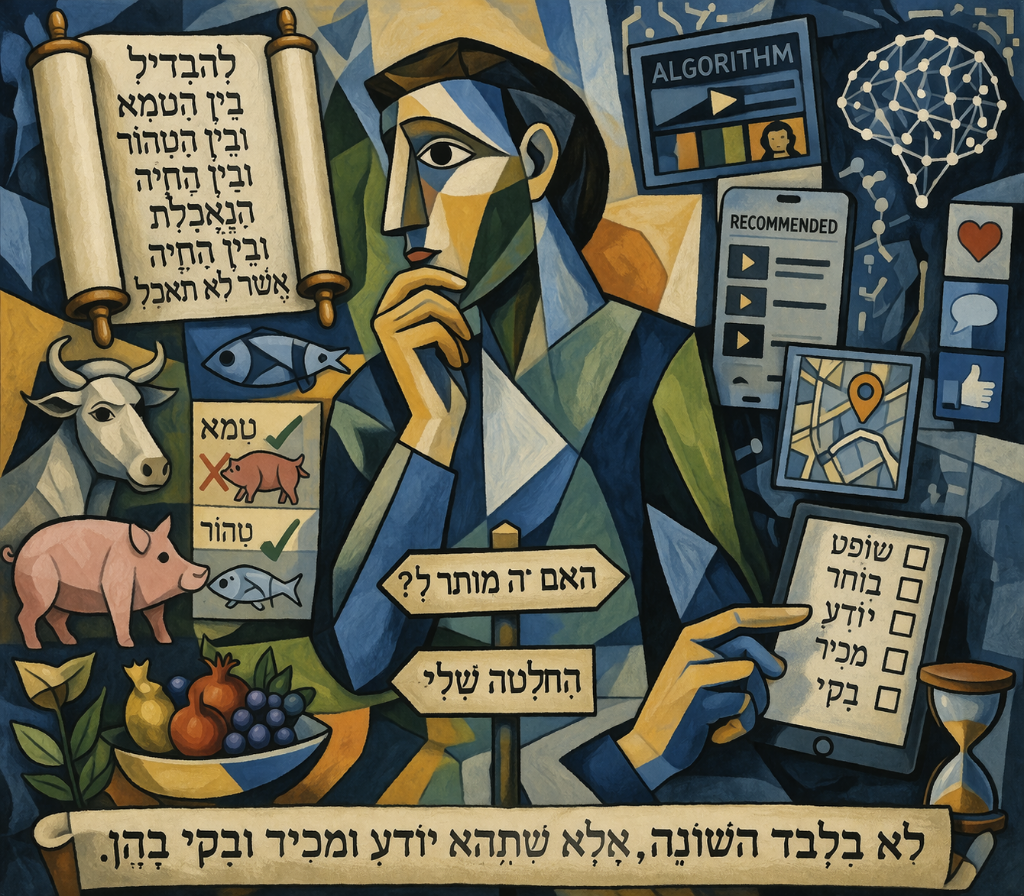
The Law of Distinction for the Digital Generation
9 min