
Have We Reached the Days of Resurrection? A Question Technology Forces Us to Ask
When a robot can carry a person's image and consciousness, and when a computer is actual physical matter, is the line between building a new body and resurrection still as clear as we thought?
A Question That Cannot Be Deferred
In recent years, Tesla unveiled Optimus — a bipedal robot capable of recognizing faces, holding conversations, learning behaviors, and operating in the physical world. Simultaneously, AI companies are enabling the training of models on all of a person's digital data: their voice, personality, and thought patterns. The question that arises is no longer science fiction: if we combine both, what exactly do we have?
Before we dismiss the question as "halachically irrelevant," it's worth pausing. Because the Sages and Rishonim never knew computers, yet they defined the concept of resurrection with such precision that this very definition compels us to ask: does today's technology meet that definition?
What Is Resurrection According to the Sources?
Let's start from the foundation. Rambam, in his "Treatise on Resurrection" — written in response to a controversy that accused him of heresy — makes it unequivocally clear: resurrection is the return of the soul to the body. Not a symbol, not a metaphor, but a process in which the body that died returns to life. Ramban, in his work "Sha'ar HaGemul", expands further: not only does the soul return to the body, but there is a deep divine purpose in the fact that this specific body — with its limbs and its form — is the one that rises.
"That which we deny and from which we distance ourselves is the claim that the soul will never return to the body and that it is impossible for it to do so — for this denial leads to the denial of miracles... and constitutes heresy" — Rambam, Treatise on Resurrection
An immediate question arises: if the body completely decays after death, what exactly returns to life? This is a question the Sages already posed, and their answer is surprisingly and remarkably relevant.
The Luz Bone: The "Source Code" of the Human Body
In Midrash Bereishit Rabbah, Parasha 28, it is told that Emperor Hadrian asked Rabbi Yehoshua ben Chananya: from what does the Holy One, blessed be He, rebuild a person in the World to Come? He answered: from the "luz of the spine" — a small bone that never decays. Hadrian attempted to prove it didn't exist and failed: they ground it and it was not ground; they burned it and it was not burned; they placed it on an anvil and the hammer broke.
"One bone remains from the body, and at the time of resurrection the Holy One, blessed be He, softens it with the dew of resurrection, and the bone becomes like leaven in dough, and from it the entire body is rebuilt" — Bereishit Rabbah, Parasha 28, and parallelly in Zohar Vol. II
In other words: according to the Sages, resurrection is not creation ex nihilo. It is the rebuilding of the body on the basis of a preserved "nucleus" — a nucleus containing all the information needed to reconstruct the full body. What is that if not digital information? What is that if not a source file from which the entire system is rebuilt?
Rambam as Philosopher: The Body as "Instruments for the Soul's Actions"
Here comes the most fascinating point. Rambam, in that same Treatise on Resurrection, defines the body in a striking phrase: "the body is indeed the totality of instruments for the soul's actions." The body is hardware. The soul is software. Death is the shutdown. Resurrection is the reboot of the same software on a freshly built hardware system.
Now we ask: if Tesla builds a robot from physical materials and runs the digital "consciousness" of a deceased person on it — would Rambam have rejected this? By his own definition, the body is "instruments." Does it matter what the instruments are made of?
"And all that is in the body is divided into three parts: instruments by which nourishment is perfected... instruments by which reproduction takes place... and instruments by which the body's affairs are ordered" — the entire body is a system of instruments
The Question of Identity: What Makes a Body the Same Person?
Here lies the great dispute among the Rishonim, and it is precisely the most relevant to our question. Ramban in Sha'ar HaGemul asks: what is the necessity for this specific body to rise? After all, all the body's cells are replaced within a few years, and there is no "same body" even during a person's lifetime. His answer: there are "deep secrets" in the form of a person — meaning there is an identity that does not depend on the specific matter, but on the form, the pattern, the organization.
This is precisely the "Ship of Theseus" question that philosophers have grappled with for centuries: if every plank of a ship is replaced, is it still the same ship? The Jewish answer, from the Zohar to the Rishonim, is that identity is preserved in the "luz bone" — in the nucleus of information — not in the specific physical matter.
"The creation in this form was not arbitrary or purposeless, but for a great need and a noble reason, and its Maker, may He be blessed, desires its continuation" — Ramban, Sha'ar HaGemul
The Computer Is Physical Matter: An Argument That Cannot Be Ignored
The common objection to "digital resurrection" is that it is spirit, not body. But this is a factual error. A computer is silicon, metals, electricity — physical matter in every sense. When a consciousness "runs" on a processor, it runs on electrons passing between states. That is physics, not metaphysics. Tesla's robot is a physical body: a metal skeleton, actuators, sensors, a computing brain. If the "personality" of a deceased person runs on it, what exactly is missing from Rambam's definition?
The halachic claim that a computer "is not a body" is like arguing that a transplanted body containing tissues taken from another person "is not the same body." The Sages ruled according to the reality of their time. The question is not what they ruled, but what they would have ruled had they known our reality.
The Soul — The Real Challenge
Until now, the physical question. But there is a deeper question here, which no computer solves: the soul. According to all the sources — from Rambam to the Arizal to Rav Kook — the soul cannot be duplicated. A person who died left behind data. But data is not a soul. A behavioral pattern is not the inner "I," the divine spark.
Here the Rishonim speak with one voice: resurrection is not the building of a new body that looks like so-and-so, but the return of the same soul to a body. As ruled: "that same body that died — it is the one that shall rise in resurrection, and not a new body, as it is written 'your dead shall live' (yich'yu) and not 'they shall be created.'" The emphasis is on "yich'yu" — the uniqueness of the soul that returns, not a copy.
"If another body were to come into being, it would be a different one. Therefore there must necessarily be a small bone that remains in the body, not subject to decay... from which flows a substance to spread through the entire body" — Rabbi Menachem Mendel Schneerson, Igrot Kodesh
So Have We Arrived? The Split Answer
The technology of 2026 solves the question of the body and does not solve the question of the soul. It can rebuild "instruments for the soul's actions" (in Rambam's words) and even run on them a pattern that resembles the personality of a deceased person. But we do not possess — and perhaps never will — the technology to take a soul that has ascended to heaven and return it.
The fascinating conclusion is this: technology has proven that the Sages were right in their formulation. They did not say "the biological body will rise" — they said "from it the body will be built." In other words, even in their time, they understood that matter is not the body — the pattern is the body. What technology lacks is not the ability to build a body. What it lacks is what no processor can produce: a divine spark.
We have built the body. What remains for us is to discover who breathes the soul into it.
Summary: A Question That Opens Worlds
Have we reached the resurrection of the dead? Like everything in Judaism, this will likely remain a matter of dispute. But it is impossible to ignore the idea that in 2026 we have indeed reached the resurrection of the dead.
Sometimes it is hard for us as human beings to believe that we have arrived at the destination. Redemption is something that always seems far away. But is there not at least the slimmest of chances that we have merited it — that we are in a generation that not only returned to the Land of Israel and came back to life as a people, a generation that not only revived a language, but also a generation in which human beings can rise from the dead?
The Sages assumed that the Holy One, blessed be He, would build the body from the "luz bone" and return the soul into it. They did not discuss the question of what would happen if human beings themselves built a body — because that seemed completely beyond the realm of human possibility. Now it no longer is. And perhaps — just perhaps — this is exactly what the prophets saw from afar.
Sources for further reading:
Treatise on Resurrection — Rambam | Article on Resurrection (Daat website) | Sha'ar HaGemul — Ramban (Sefaria) | Bereishit Rabbah Parasha 28 (Wikisource) | Igrot Kodesh (Chabad.org) | Luz Bone (Wikipedia) | Rabbi Uri Sherki on Resurrection
Related Articles
What AI Should Learn From the Greatest Census in the History of Israel
8 min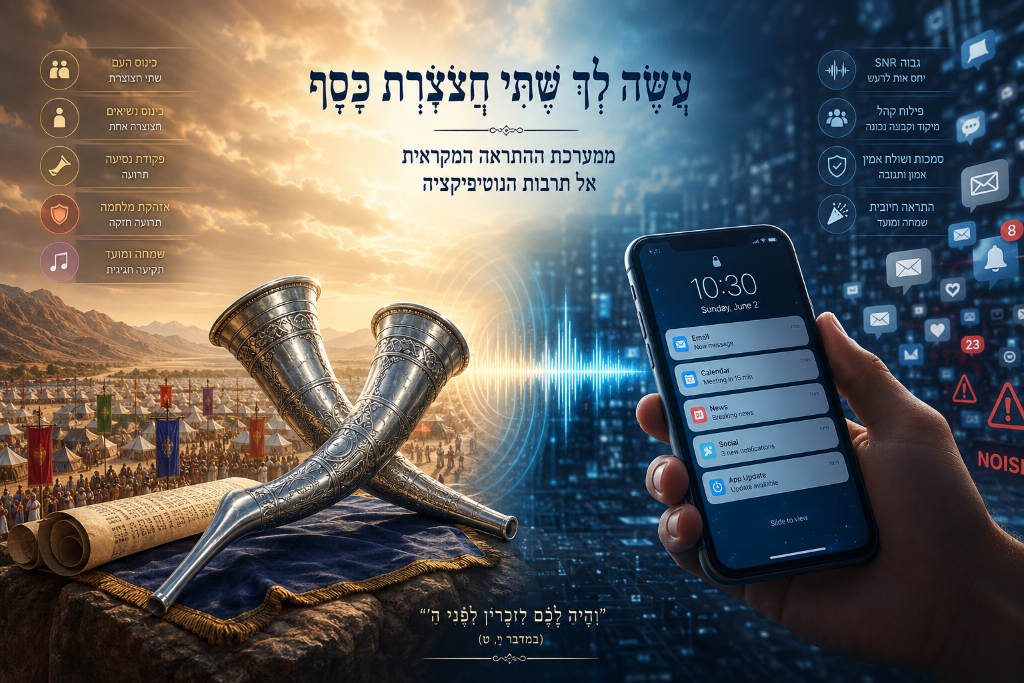
Make Yourself Two Silver Trumpets: From the Biblical Alert System to the Culture of Notifications
9 min