
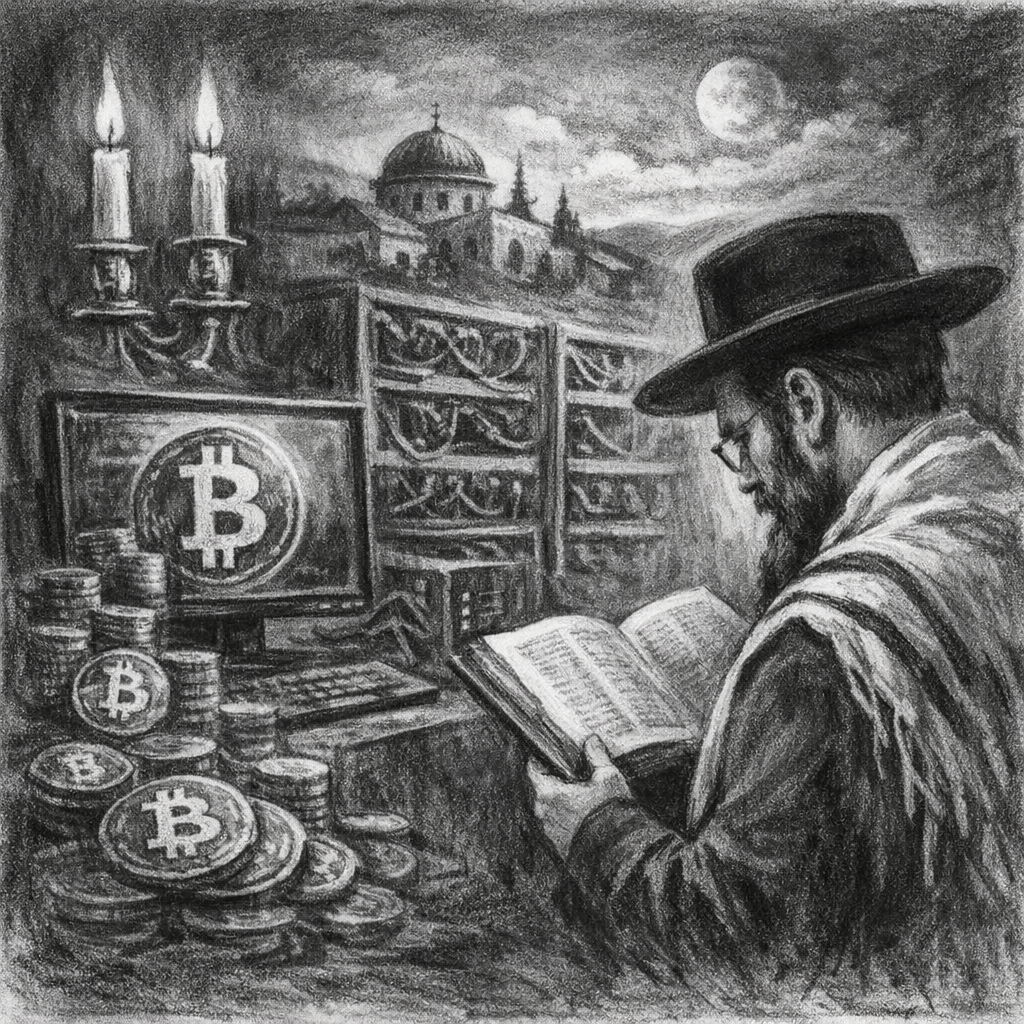
Bitcoin Mining on Shabbat
In our generation, the world of technology presents halakhic authorities with new questions that were never contemplated by the earlier sages. One of the significant contemporary questions is that of mining Bitcoin on Shabbat.
In our generation, the world of technology presents halakhic authorities with new questions that were never contemplated by the earlier sages. One of the significant contemporary questions is that of mining Bitcoin on Shabbat. In this matter, several primary halakhic aspects must be examined: Does operating a computer on Shabbat constitute grama (indirect causation)? Is there an issue of shevitat kelim (the resting of one's utensils)? And if the work is performed automatically, may one benefit from its results on Shabbat or afterward?
I. The Nature of Bitcoin and the Mining Process
Bitcoin is a digital currency based on blockchain technology. "Mining" Bitcoin refers to a process in which a computer performs highly complex mathematical computations, competing with other computers worldwide in order to validate transactions and add them to the blockchain. The winner of this competition receives newly generated bitcoins as a reward.
This is therefore a continuous data-processing operation performed by specialized computers that often run twenty-four hours a day, seven days a week. The question before us is whether one may allow such computers to operate on Shabbat and receive the Bitcoin reward if successful.
II. Computer Operation as Grama (Indirect Causation)
The definition of grama on Shabbat is discussed in the Talmud and among the Rishonim. The Talmud (Shabbat 120b) teaches that one who extinguishes a fire indirectly, by placing vessels of water in front of it so that they will eventually burst and extinguish the fire, is exempt but prohibited. From this it emerges that grama refers to a situation where the melakhah is performed by another force indirectly, not directly by the person.
In Responsa Rashba (Vol. I, §522), it is explained that grama is rabbinically prohibited, and in cases of great need leniency may apply. Similarly, the Rema (Orach Chayim 334:22) rules that while grama on Shabbat is forbidden, it is not a Torah-level prohibition. Rabbi Shlomo Zalman Auerbach addressed issues of grama in the era of electricity in his works Me'orei Esh and Minchat Shlomo (Vol. I, §11), ruling that setting a mechanism before Shabbat to operate automatically, such as a Shabbat timer, is not considered performing melakhah on Shabbat, provided it was arranged beforehand.
In our case, when a person activates the mining computer before Shabbat and allows it to run automatically, it would seem at first glance to resemble grama, which is not a Torah prohibition. However, one must distinguish between incidental grama and a system designed specifically to operate on Shabbat. In the Talmudic example, the person performs an action unrelated in itself to the melakhah, and the result occurs indirectly through natural forces. Here, however, the entire function of the computer is to mine Bitcoin. The computer itself performs the work, and the person merely initiated it. Thus, even if there is an element of grama, it may still be prohibited.
III. Shevitat Kelim (Resting of Utensils)
From a Torah perspective, there is no obligation for one's utensils to rest on Shabbat. The verse states, "You shall not do any work, you, your son, your daughter, your servant, your maidservant, and your animal," referring to people and animals, not inanimate objects. The Sages did not institute a general prohibition of shevitat kelim, though they prohibited driving one's animal (mechamer) and instructing a non-Jew to perform melakhah.
The Ritva and Ran (Shabbat 17b) debate the parameters of shevitat kelim. The Ritva maintains that there is no obligation whatsoever for utensils to rest, while the Ran suggests there may be a lechatchilah prohibition, though not Torah-based. In Responsa Igrot Moshe (Orach Chayim IV, §60), Rabbi Moshe Feinstein discusses machines operating on Shabbat and rules that there is no intrinsic prohibition of shevitat kelim, though if commercial profit results from their operation, concerns such as mar'it ayin (appearance) or engaging in business may arise.
Accordingly, a computer mining Bitcoin, being an inanimate object with no inherent obligation of rest, would not be prohibited solely due to shevitat kelim. However, other prohibitive considerations may apply.
IV. Benefiting from Work Performed on Shabbat (Ma'aseh Shabbat)
A separate question is whether one may benefit from Bitcoin mined on Shabbat. The Talmud (Eruvin 38a; Pesachim 25b) establishes that work performed automatically, without human causation, may be permitted for benefit afterward. However, this applies only when the person neither intended nor initiated the result.
In this case, the individual activated the computer specifically for mining and received direct financial profit. Many authorities adopt stringency regarding ma'aseh Shabbat, the fruits of work performed on Shabbat, even when done inadvertently. Rambam (Hilchot Shabbat 23:7) writes that work performed unintentionally may be permitted to the transgressor after Shabbat, but if done intentionally, it is forbidden to him until after Shabbat.
The Chazon Ish (Orach Chayim 58:3) addresses automatic mechanisms on Shabbat and concludes that when a person intentionally prepared a system for his own benefit, he may not benefit from its results on Shabbat itself, even if he performed no direct action. By extension, Bitcoin earned through mining on Shabbat would fall under this restriction.
V. The Prohibition of Business Activity and Mar'it Ayin
An additional halakhic consideration concerns business activity on Shabbat. The Sages prohibited engaging in commerce or commercial discussion on Shabbat. Ramban writes in Torat Ha'adam that any matter involving financial business is prohibited on Shabbat. The Shulchan Aruch (Orach Chayim 306:1) rules that speaking about commerce is forbidden.
Bitcoin mining for financial gain is clearly a commercial enterprise and may therefore be rabbinically prohibited as business activity on Shabbat. Furthermore, in public settings, it diminishes the honor of Shabbat. Observers may conclude that the owner does not respect Shabbat but exploits it for income. In large-scale mining operations involving numerous machines, there may also be concerns of mar'it ayin, which the Sages prohibited.
Conclusion
After examining all relevant aspects, the conclusion appears to be that Bitcoin mining on Shabbat, even if the computer was activated before Shabbat, is prohibited for several reasons:
It cannot be equated with pure grama, since the system is intentionally designed for this activity. One may not benefit from the fruits of work performed on Shabbat (ma'aseh Shabbat) until after Shabbat. The activity constitutes commercial enterprise, which the Sages prohibited on Shabbat.
Therefore, mining computers should be shut down before the onset of Shabbat and not left running during Shabbat, even if activated beforehand. If one failed to do so, the Bitcoin mined on Shabbat is prohibited for benefit until after Shabbat, after which it becomes permitted.
May we merit to observe Shabbat in accordance with halakhah and to add sanctity and honor to the holy day. Amen.
Related Articles

Make Yourself Two Silver Trumpets: From the Biblical Alert System to the Culture of Notifications
9 min
What AI Should Learn From the Greatest Census in the History of Israel
8 min